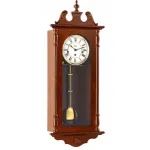
Modern wall clocks chiming and striking
Winding
Wind your clock fully every 7 days for optimum performance To wind the clock use the original key or a well fitting key. Turn the key clockwise gradually until it starts to resist then stop. The centre winder is for the timekeeping, the right winder is for the quarter-hour chime, and the left winder is for the hour strike.
Fitting the Pendulum
Hang the pendulum onto the pendulum leader (see image below).
Setting The Beat
Move the pendulum slightly to the left or right and release it gently. You should hear an even “tic – toc” sound. If the tick-tock is uneven or the clock stops, follow the “putting in beat” procedure. A clock may get out of beat during handling, moving or regulation. To put the clock in beat: Make sure the clock is hanging straight. Listen to the tick tock. Gently push the pendulum leader slightly past the point of resistance. Listen to the tick tock again. If it is more uneven, push the leader in the opposite direction and listen to the tick tock again. After several tries, you will be able to get the tick and tock sound to be evenly spaced, and the clock is then “in beat”.
Chime Setting and Time
The chime shut-off lever is located to the left of the numeral 9 usually. Turn the lever down if you want the clock to be silent.
The minute hand (long hand) must be moved clockwise to set the clock to the correct time. Never turn the hour (short) hand, it moves automatically. After two hours the chimes will be automatically synchronized.
If the clock is striking the wrong hour, move the hour hand (short hand) to point to the hour that the clock just struck whilst holding the minute hand still.
Regulation
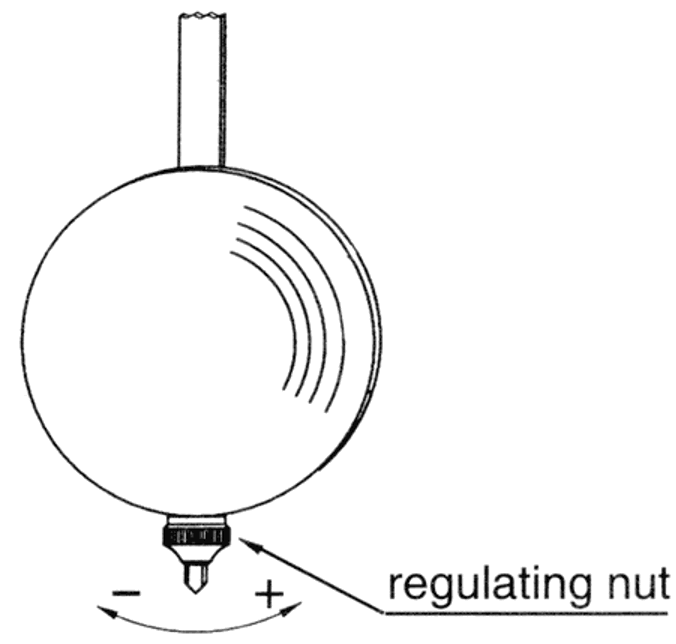
To make the clock run slower – turn the regulating nut below the pendulum to the left.
To make the clock run faster – turn the regulating nut to the right.
One turn of the regulating nut changes the clock’s rate by approximately 1 minute per day. It is normal for a clock to run a few minutes fast or slow per week only one revolution of the nut in the appropriate direction and reset the hands to time each day until the clock is keeping adequate time.
Maintenance
To maintain the clock you should have it checked and serviced every 4-5 years. Do not attempt to oil a clock yourself. This should be done by a qualified repairer. Over-oiling a clock can affect the running and condition of the clock.